Would You Like a Free Expert Consultation?

Las Vegas Handyman 

Not every project goes as well as planned. We would be happy to spend a few minutes answering your questions.

Subscribe by Email

Your email:

Browse by Tag

Pro Handyman Blog

Current Articles | RSS Feed RSS Feed

Sanding Drywall To Remove Scratches


drywall sandingDrywall joint compound (known as “mud” in the trades) sands very easily. With the right tools and know-how, you can do a professional looking job.

Many people use heavy grit sandpaper to chew off the compound, while working the sandpaper with lots of pressure. This gets rid of compound fast, but leaves a nasty surface to finish. The heavy grit sandpaper will leave scratches and gouges, while excessive pressure will scuff the paper face on the drywall.

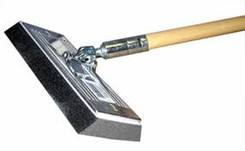
Try buying a drywall hand sander and some 120-150 grit sandpaper for it. The tool looks like a trowel and has a big surface to keep the finish level. It has a fat handle and some clamps to hold the paper as you work.

While you’re at it, buy a dust mask and some goggles to keep the dust out of your eyes and nose.

Assuming you have floated out the compound enough (the more you float it out, typically the less noticeable it will be.

Load the paper into the sander by clamping one side and wrapping the paper so it is taut on the sanding surface, then clamp the other side. This is important, because if there is play in the paper, you won’t have as much control over the sanding motion.

Hold the sander at a slight angle and use long uniform motions. Don’t hold the sander perfectly vertical or horizontal, but somewhere in between. The goal here is to blend in the surface so after it’s painted, you won’t be able to tell where the joints are.

For inside corners, use a sanding sponge with a tapered edge. If you try to use the hand sander here, you will gouge the opposite side and create more work, so sand within a few inches and then go to the sanding sponge. One edge of the sponge tapers to a sharp point which is perfect for finishing the corner. The grit of the sponge should be fine, so just run the sponge vertically on both sides of the corner until clean.

Unfortunately, you will have gouges and depressions in the surface, and many people try to sand these flaws out. Instead, just add another thin layer or two of joint compound. Use a 6-inch taping knife and scoop just a tiny amount of compound on its edge, then run it along the flaw. You can hit it with the sandpaper later.

Finally, you can use a hand-held work light and hold it against the wall so that its light shines along the wall. The light will cast shadows on your work and let you know which areas need more filling and sanding.

Tags: 

Repair A Sliding Glass Door Latch


sliding glass doorWhen your sliding glass door doesn’t cooperate, it’s time to break out the tools. With latching and locking problems, you need to look to the handle and latch assembly. The handle has an integrated latch that mates with a “keep” on the door frame. The keep looks somewhat like a hook and can be adjusted by two screws. This holds to door tight to the frame and keeps the opening secure.

If you have to push hard to get the latch and the keep to align or have to push on the latch extra hard, you might benefit from a simple latch assembly adjustment and maybe some lubrication.

With the door open, cycle through the locking mechanism at the latch several times. It should easily move into the locking position. If not, use some spray lubrication and spray the moving parts inside the opening and again cycle through the movement to spread the lubricant around.

Now partially close the door and extend the latch. You want to make sure it is properly aligned with the keep on the jamb. If they are slightly off, slightly loose the keep and move it up or down so that it mates perfectly with the latch assembly.

Although you may not have a keep that looks like a hook (it may look like an opening on the jamb), you will still be able to adjust the latch/keep for easy locking.

Carpentry: Finding Wall Studs Without A Stud Finder


carpentryAt some point you will have a carpentry job that will require you to find wall studs. When you most need it, your stud finder will be out of battery life. Now you’ll have to go back to the Neanderthal days to find wall studs (like 1975). Here are some of the easier ways.

You can certainly knock on the wall horizontally until the hollow sound becomes more of a solid sound. You could also try shining a bright light down the wall and look for small humps in the wall, or you could apply some reason.

Openings in walls (like doors and windows) will have wall studs next to them for strength. You can measure out 16” from this point and at least you will be close. Also, during new construction, electrical boxes (outlets and switches) are secured to wall studs on one side. You can either use the knocking technique or take off the face plate of the outlet or switch and look through the gap between the drywall and box to see which side the stud is lying. Lastly, you can always remove a strip of baseboard and look behind it. You will see where the drywall has been nailed to the studs, but don’t always trust that. You can cut away a little of the drywall to be sure as the baseboard will cover it up anyway.

Tags: 

How A Las Vegas Handyman Stays Cool In The Heat


las vegas handymanBeing a Las Vegas handyman requires one to work in pretty extreme conditions. In the wintertime when it can hover near freezing, you can always add layers of clothing and drink something warm. But it’s the summer heat of the desert that really makes me suffer. The following are things I do to make sure I make it safely through the day.

If I know I will be working outside for extended periods of time, bring the right clothing. In addition to sunscreen, wear a wide brimmed hat and sunglasses, and wear loose fitting light colors…even a long sleeved shirt. There is a reason you see so many landscapers working with long-sleeved shirts on; they keep the sun off of your skin and still allow you to sweat which will evaporate and keep your skin cool. You can also keep a wet rag around your neck to help cool you.

Take advantage of ANY shade you can find. For example, if you are prepping a new sprinkler valve for installation, do it under a shade tree rather than leaning over the sprinkler box directly in the sun.

Finally, and most importantly, you must hydrate. Drink plenty of water frequently. If you sip water throughout the day and maybe have a regular snack for energy, your body will function better. If you get to the point where you feel thirsty, you are already in trouble.

I learned a valuable trick when installing a sprinkler system in 110-degree heat many years ago. Fill a one gallon jug of water about 2/3rds full and put it in the freezer overnight. As the water freezes and expands it will fill most of the bottle. When you head out into the heat the next day, remove the nearly full jug and add water to fill it up. As you work throughout the day, the ice will slowly melt leaving cold water for the majority of the day. It sure beats drinking warm water.

Lubricate An Overhead Garage Door


garage doorThat squeaking noise every time you press the garage door opener button may be telling you something. It’s time to lubricate the garage door and it’s hardware. You can buy a graphite spray made for garage doors. They also make garage door lubricant in a tube.

Before you start lubricating everything in sight, make sure all the hardware is tight. Loose hinges or brackets won’t benefit if they are moving as the garage door moves. So give your door an inspection and tighten the parts up. Also make sure the tracks are aligned so that the rollers travel smoothly.

Use the spray and spray the torsion spring above the door (it’s the black coil above the garage door). This has a lot of tension in it so don’t try to work on it, but you can spray lubricant on it. Go on to the moving parts of the door. Lubricate the hinges where they connect one section of door to another. Lubricate the rollers so that they don’t get hung up in the assembly or the track. You can also lubricate the tracks that guide the rollers but they do tend to collect dirt. Once you have lubricated up the door and it’s hardware, run it through a few cycles. You should notice a quieter and smoother operating door.

Tags: 

How To Cut A Hole In Tile For Shower Grab Bar


ceramic tile bitThere may come a day when you need to cut a hole in ceramic tile. If you install shower doors in a tub enclosure, or want to install a shower grab bar, or even some decorative item, like a hand towel holder, you’ll need to drill a hole into the tile to mount it to the wall. Drilling through grout is a lot easier than ceramic tile.

Ceramic tile has a glaze on it that makes it difficult to get a drill bit to bite in. In some cases you can attempt to break through the glazing by tapping something hard and sharp into it, but that is risky. You could crack the tile and then your quick weekend job just got much longer. Once the glazing is penetrated, you could use a masonry bit to chew through the tile.

There is, however, an easier way. The right tool makes the job much easier. Use a glass and tile cutting bit chucked into your drill. The bit is shaped like the tip of a spear and cuts wonderfully. The tip bites into the glazing and keeps going through the tile. The sharp tip makes it so that the bit doesn’t wander all over the surface of the tile, but instead stays in place and just plows a hole.

Once the hole is drilled you can mount whatever it is you have to the surface and into the wall stud, or you can use a wall anchor.

Tags: 

Toilet Refill Tube Can Cause Leak


toilet fill tubeAll kinds of things can go wrong inside of a toilet tank. Parts sitting in water all their lives decay and can even make weird noises. The most common parts that need replacing are the fill valve and the flapper.

The fill valve is a part that allows water to refill the tank. Water enters through the bottom of the tank, up through the fill valve. When the water reaches a pre-determined level in the tank, the water shuts off. While the tank is refilling, there is a refill tube that carries water to the overflow tube in the center of tank. This water flow allows for rinsing of the bowl as the tank refills.

If the skinny black refill tube cracks or comes off of the overflow tube, there could be problems. There is a good force of water that comes from this small tube and if it is pointed at the wrong spot, get ready to clean up some water. The first sign of a problem is going to be a hissing noise and water leaking from the top of the toilet tank. The water should eventually stop as the tank refills and the fill valve shuts off the water.

The fix is to either replace the small section of tubing, or if it is in good shape, place it securely onto the angle adapter, which sits on top of the overflow tube.

Tags: 

Carpentry: Repair A Laminated Edge


carpentrySome carpentry jobs are odd. Take for example a counter top edge that has become damaged like laminate or even melamine shelving… Even the edge of a wood grained board. These can all be repaired using the correct adhesive backed strips and an old clothes iron.

Instead of buying solid wood, woodworkers can buy laminated veneer plywood. This sheet looks like a piece of solid wood until you look at the edges. At the edges it looks like typical plywood. You can buy strips of the veneer that have an adhesive backing on them. They are usually ¾ inch thick, so you may not have to shave them down or you might have to if you are using a thinner stock.

Heat up the iron hot enough to activate the glue and run the iron along the top of the strip. The heat will cause the adhesive to melt and the strips will stick to the edge of the plywood. Once you heat up the strip of wood and while the glue is still somewhat pliable, use a roller and press the veneer strip down onto the plywood edge. You want good contact with no gaps. If you wait too long, you risk allowing the veneer to lift off of the edge and create a gap.

This process can be used for some laminate countertop edges and also melamine shelving.

Tags: 

Light Fixture And Address Light Stopped Working


We get calls from homeowners that they have received a noticelight fixture from their homeowners association that their light fixture or fixtures are out. This typically means the address light and the coach lights on either side of the garage (some communities will only have the address light that is uniform).

You can sure check the bulbs, but this usually indicates that no power is getting to the fixtures. This can be traced back to the photocell. A photocell is a switch that “sees” the light. When it gets dark outside, the switch activates and allows electricity to flow to the fixtures. Conversely, when the sun rises, the switch stops the power and the lights turn off. The photocell is cheap and it’s easy to replace. The only challenge you may have is finding it. Look on the side of the house (usually the South side) for an exterior junction box with a small bulb in the middle of it. You will replace this “bulb”.

Most home centers will carry replacements and they are easy to install. Turn off the power at the main panel, remove the box cover and disconnect the switch. Reinstall the new switch (it is only 2 or 3 wires), and secure the box cover. Once you turn the power back on, you can test the photocell by placing a piece of black electrical tape over it (to trick it into thinking it is dark), and the lights should come on.

Tags: 

Drywall Stain May Be Caused By Air Conditioner


drywall repairIf you have a drywall stain on your ceiling, don’t just assume it is a roof leak. You need to climb up into the attic and snoop around. It certainly may be a roof leak, but during the summer months, particularly when it is humid, check out the air conditioner.

Particularly when it’s humid, the central air conditioner will condense and drip into a pan (just think of a cold glass of iced tea sweating on your coffee table). As the pan fills with water, the water level will rise and the water will be carried off by the condensation drain. There is a primary and secondary drain in case the primary becomes clogged. If the drain lines are clogged, the pan will back up and overflow onto the insulation and ultimately the ceiling drywall.

The first thing to check would be the pan itself. These have the tendency to rust out and leak. If this is the case, an a/c company can try to seal the pan or replace it altogether. If the pan appears to be clean and in good shape, look at the condensation lines. It may be that that the condensation line(s) are clogged with debris. These lines run to the exterior of the house and are usually cleared using compressed air/gas. I’ve seen where just the opening of the drain lines are clogged with attic insulation, so you may get lucky and be able to clear the debris quickly.

Tags: 
All Posts